
For daily drivers, golf carts and workbenches
Garage Floor Epoxy in St. Petersburg, FL
We grind, repair and coat the whole slab, then finish it with a topcoat that keeps its color in the Florida sun.
- Free on-site estimates
- Moisture test on every slab before we coat
- Prep, coats and price itemized on a written quote
An Epoxy Garage Floor for Pinellas Living
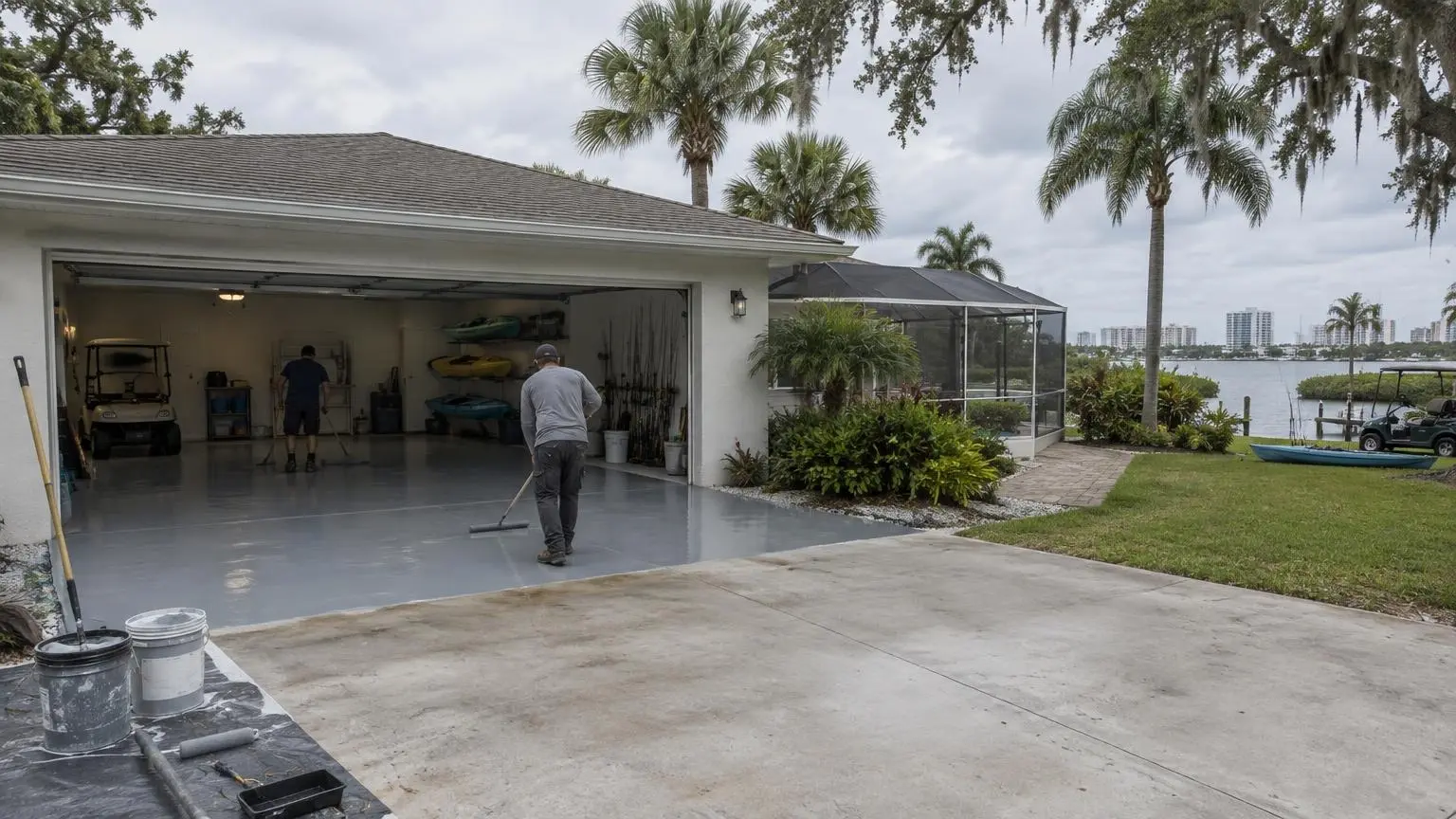
Garage floor epoxy in St. Petersburg gets tested by more than parked cars. Garages around here hold golf carts, kayaks, fishing gear, beach chairs dusted with sand, a spare fridge and often a workbench. Doors stay open through long, bright afternoons, and summer storms push rain over the threshold. Wikipedia credits the city with sunshine on about 361 days a year, so the floor takes steady UV as well as hot tires. A well-built epoxy garage floor seals the concrete against oil and water, makes sweeping and hosing quick, and keeps its look in that light. We build every one from bare, ground concrete up and explain each layer before you agree to anything.
The slab comes before the color
ACS figures on Point2Homes put the median home in St. Petersburg at 1969, and more than a fifth of local houses went up in the 1950s. Garage slabs that age often carry old porch paint, decades of oil, a clear sealer that has turned cloudy, and crack patches that no longer stick. A coating rolled over any of that inherits its weakness. So the first day of most jobs is prep:
- Diamond grinding across the full floor and along the walls with a smaller edge grinder
- Removing paint and failed coatings down to sound concrete
- Degreasing deep oil stains and grinding them back
- Filling cracks, control joints and pitted areas using a coating-compatible repair compound
- Rebuilding the spalled lip at the garage door, where years of rain have softened the edge
We use grinding rather than an acid wash because it opens the surface evenly and leaves no acid residue in the pores.
Why thin kits peel and real systems last
Most garage floor coating complaints we hear start with a one-day kit from a store shelf. HomeGuide puts DIY kits at $200 to $700 and gives water-based epoxy a lifespan of 3 to 5 years, against 10 to 20 years for solid epoxy. The difference is film thickness and bond. A thin, water-based coat sits on top of the concrete and can lift where hot tires grip it, which installers call hot tire pickup. A properly ground slab coated with a high-solids epoxy base soaks resin into the surface and builds a much thicker layer that tires cannot pull loose. That is the system we install.
How the layers go together
A typical garage floor epoxy job here has three or four parts:
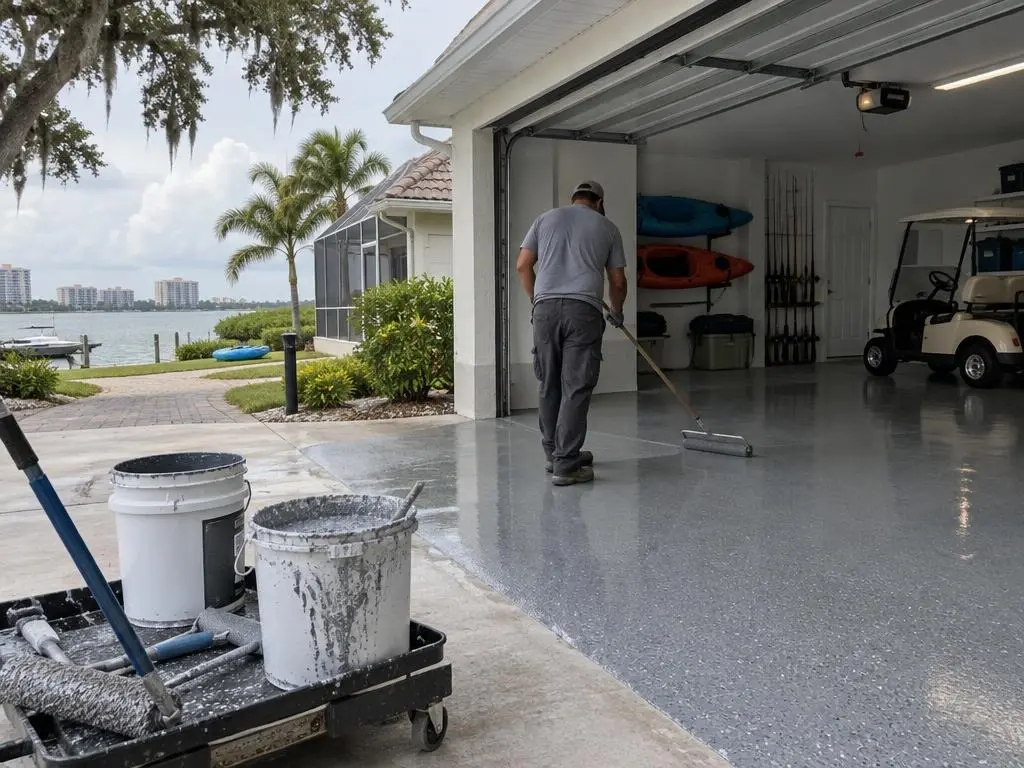
- Primer or base coat. Epoxy, rolled into the ground concrete. On slabs with higher moisture readings, we switch to a primer made to tolerate vapor.
- Color. Either a pigmented body coat for a solid finish or a full broadcast of vinyl flake into the wet base.
- Scrape and clean. Loose flake is scraped and vacuumed so the surface is even.
- Topcoat. A clear, UV-stable polyaspartic that resists yellowing, chemicals and scuffs.
Plain epoxy on its own is a strong base, yet sunlight is its weak point; HomeGuide grades it poor to fair against UV. With the door up most of the day, an untopped epoxy floor will drift toward amber. The polyaspartic top layer is what keeps a gray floor gray.
Garages that took on water
In September 2024 the National Hurricane Center recorded a 6.31-foot storm tide above mean higher high water on the St. Petersburg gauge, a new local high. A few weeks later Hurricane Milton dropped close to 19 inches of rain on the city. If your garage had standing water, the slab may still be holding moisture, and saltwater can leave salts in the pores that keep pushing out over time. We test before we quote a schedule. When a slab reads too wet, we either let it dry and retest or switch to a moisture-tolerant primer, and you hear which route we picked and the reason. A coated floor is also easier to clean out after future storms than bare concrete, since mud and debris do not soak in.
Golf carts, boats and workshops
How you use the garage changes the build. Golf carts and lawn equipment bring grit and turning tires, so we favor a flake finish with a firm topcoat. Boat trailers drip salt water, so we pay extra attention to the joints and the lip at the door, where water collects. A workshop with rolling tool chests and dropped tools benefits from a thicker base. Plan for the downtime too. HomeGuide advises keeping vehicles off epoxy for 2 to 7 days, and Bob Vila puts it at about 12 hours before walking and 3 days before parking. A polyaspartic topcoat shortens that, which is one more reason we use it.
Living with the finished floor
Upkeep on a coated garage floor is light. Run a broom or dust mop over it to pick up sand, rinse with a hose or a mop and mild cleaner for spills, and put mats under bikes and kickstands. Wet coatings can get slick, so we add texture by default, and more at the door where rain blows in. If you ever see a chip from a dropped tool, it can be patched locally instead of redoing the floor. Ask about that at the estimate, and we will explain how a repair blends into the finish you choose.
What a Garage Floor Epoxy Job Includes
Every item below appears as its own line on your written quote, so the cost of each part is clear.
Moisture testing
Readings taken on the slab before we set a schedule or pick a primer.
Diamond grinding
Field and perimeter taken down to porous, clean concrete.
Crack and spall repair
Cracks, joints, pits and the worn edge at the door filled and leveled.
Coating removal
Old paint, sealers and failed kits taken off before anything new goes down.
Epoxy base coat
A high-solids epoxy layer that bonds into the ground surface.
Flake or solid finish
Full vinyl flake broadcast or a single pigmented color.
Polyaspartic topcoat
A clear, UV-stable layer with added grip.
Garage Floor Epoxy Cost Ranges
| Job | Published range | Source |
|---|---|---|
| Installed epoxy, per square foot | $4 to $10 | HomeGuide |
| One-car garage | $1,200 to $3,900 | HomeGuide |
| Two-car garage | $1,600 to $5,800 | HomeGuide |
| Three-car garage | $2,300 to $8,600 | HomeGuide |
| Crack and chip patching | $25 to $250 | This Old House |
| Typical contractor job minimum | $500 to $1,000 | HomeAdvisor |
These are national figures from published cost guides, not our price list. Old coatings, crack repair, a slab that flooded and the finish you choose all push the total up or down. We commit to the figure on the quote we hand you after testing the slab.
From Bare Slab to Coated Floor
1. Visit and test
We measure, take moisture readings and note stains, cracks, old coatings and any water damage.
2. Written quote
In writing: which system, how many coats, what prep and the total.
3. Open up the concrete
The slab is ground wall to wall, then cracks, joints and the door edge are repaired.
4. Base and color
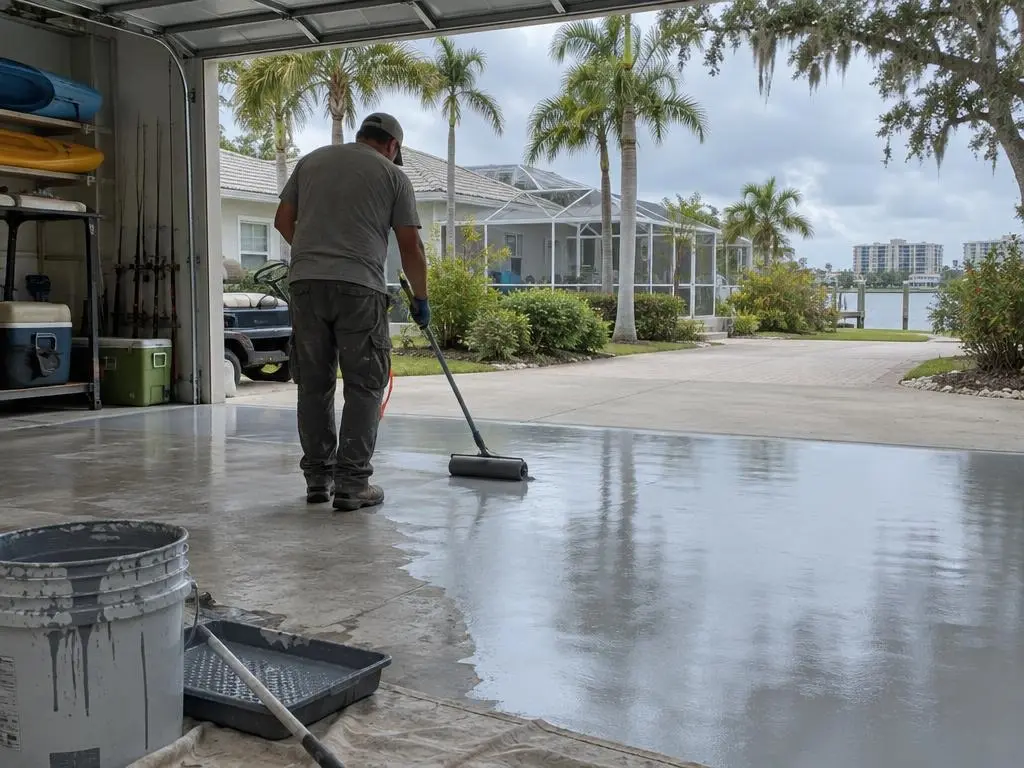
We roll the epoxy base and broadcast flake or apply the color coat, watching humidity and dew point.
5. Topcoat and hand-off
The clear polyaspartic layer goes on, followed by times for foot traffic, storage and cars.
Why Choose Us for Garage Floor Epoxy
Edges get the same prep
We grind along walls and around posts with an edge tool, where coatings most often start to peel.
Thick base, UV-stable top
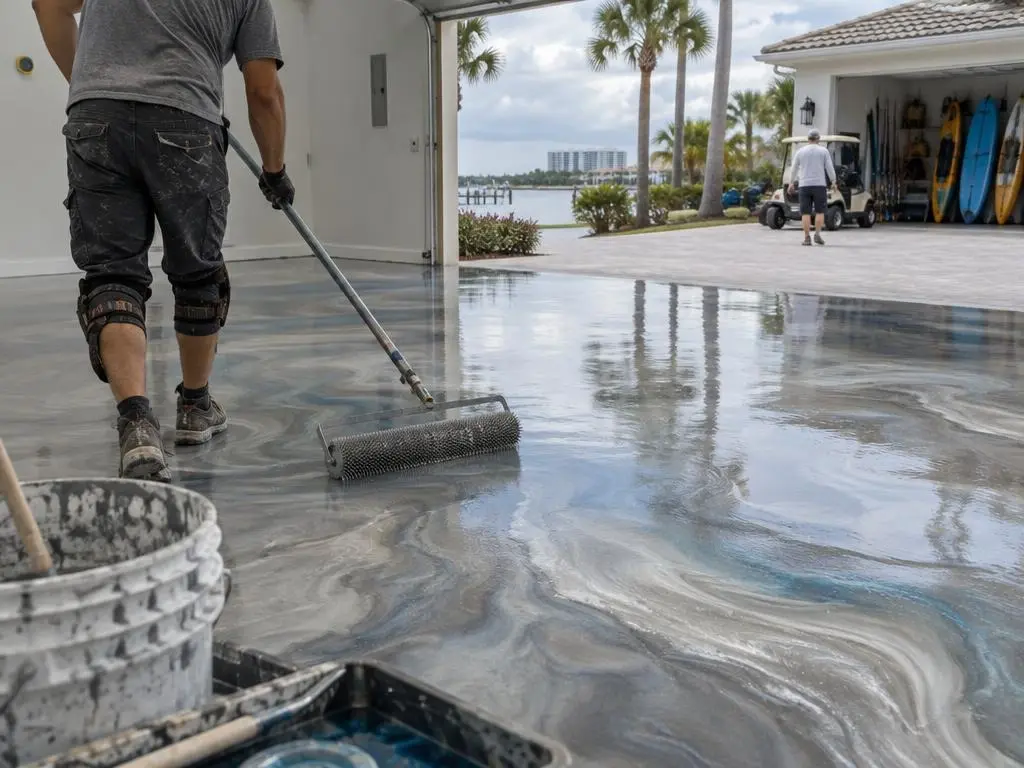
Epoxy provides the build and the bond, and polyaspartic on top keeps the color in sun.
Honest about wet slabs
If a slab is not dry enough, we tell you and change the primer or the date instead of hoping.
Garage Floor Epoxy Questions
Can you put epoxy over my painted garage floor?
Not over the paint. A new coating holds only as well as the layer beneath it, and old paint lets go. We grind the paint off, test the bare concrete and coat that.
Will hot tires lift the coating?
Thin, water-based kits rolled onto unground concrete are the usual victims of hot tire pickup. A ground slab with a high-solids epoxy base and a polyaspartic topcoat bonds far better and resists it.
How many days does a garage floor epoxy job take?
Hands-on work usually fills one or two days, depending on how much prep the slab needs and which system you choose. Parking comes later: HomeGuide says 2 to 7 days for epoxy, and less with a polyaspartic topcoat.
Is a coated garage floor slippery when wet?
A smooth one can be. We broadcast flake or mix fine grit into the topcoat, and the doorway, where rain comes in, can get extra texture.
Should I wait to coat a garage that flooded?
Wait until moisture readings say the slab is ready. We test at the estimate, check for salt and tell you whether to coat now, hold off, or go with a moisture-tolerant primer.
Garage Floor Epoxy Service Areas
- Epoxy Flooring in St. Petersburg, FL
- Epoxy Flooring in Gulfport, FL
- Epoxy Flooring in Pinellas Park, FL
- Epoxy Flooring in Seminole, FL
- Epoxy Flooring in Largo, FL
- Epoxy Flooring in Clearwater, FL
- Epoxy Flooring in Dunedin, FL
- Epoxy Flooring in Safety Harbor, FL
- Epoxy Flooring in Oldsmar, FL
- Epoxy Flooring in Palm Harbor, FL
- Epoxy Flooring in Tarpon Springs, FL
- Epoxy Flooring in Treasure Island, FL
- Epoxy Flooring in St. Pete Beach, FL
- Epoxy Flooring in Madeira Beach, FL
- Epoxy Flooring in Indian Rocks Beach, FL
- Epoxy Flooring in Belleair, FL
- Epoxy Flooring in Kenneth City, FL
- Epoxy Flooring in South Pasadena, FL
- Epoxy Flooring in Redington Shores, FL
- Epoxy Flooring in Lealman, FL
- Epoxy Flooring in Feather Sound, FL
- Epoxy Flooring in East Lake, FL
- Epoxy Flooring in Bay Pines, FL
- Epoxy Flooring in Tierra Verde, FL
Get a Garage Floor Epoxy Estimate
Garage floor epoxy estimates are free and done on site, in St. Petersburg and across Pinellas County.