
Sun-stable floors with a short downtime
Polyaspartic Garage Coatings in St. Petersburg, FL
A coating that resists yellowing in strong sun and can take a car in about a day, installed over properly ground concrete.
- Free on-site estimates
- Moisture test on every slab before we coat
- Prep, coats and price itemized on a written quote
Fast Cure, Strong Sun, Real Prep
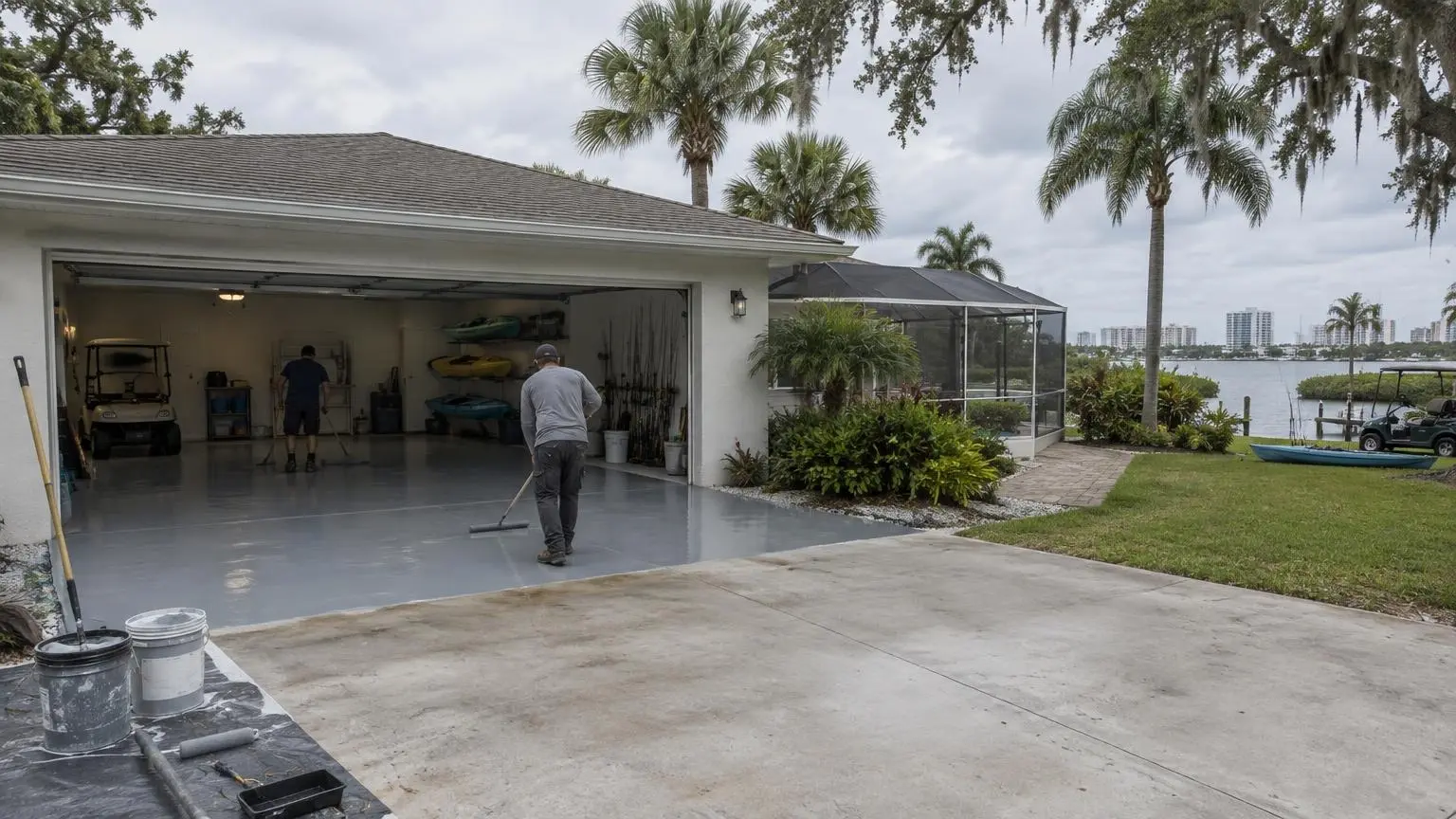
Polyaspartic garage coatings answer two questions St. Petersburg homeowners ask us most: will the floor turn yellow in the sun, and how long will I be parking in the driveway? A polyaspartic floor coating belongs to the polyurea family of resins. HomeGuide grades it excellent for sunlight exposure, while ordinary epoxy only earns poor to fair, and lists a full cure of 1 to 2 days; heavy vehicles can roll on after 24 to 48 hours. By comparison, epoxy may keep the car out for as long as a week. In a city with sunshine on about 361 days a year and garages that double as open-air workshops, both of those points carry real weight.
What makes polyaspartic different
Epoxy and polyaspartic are both two-part resins, but they behave very differently on the floor:
- UV stability. Polyaspartic stays clear and holds color in direct sun, while untopped epoxy tends to amber.
- Cure speed. Bob Vila puts polyaspartic at about 3 to 4 hours before walking and 24 hours before vehicles, against roughly 12 hours and 3 days for epoxy.
- Film thickness. HomeGuide lists polyaspartic at 2 to 6 mils per coat and epoxy at 10 to 20 mils, so a polyaspartic system usually needs more coats, or a base that adds build.
- Lifespan. HomeGuide estimates a life of 10 to 20+ years when the slab is prepared well.
In practice, the strongest garage systems here often pair the two: an epoxy or polyaspartic base, flake if you want it, and a polyaspartic top layer.
Short working time means careful hands
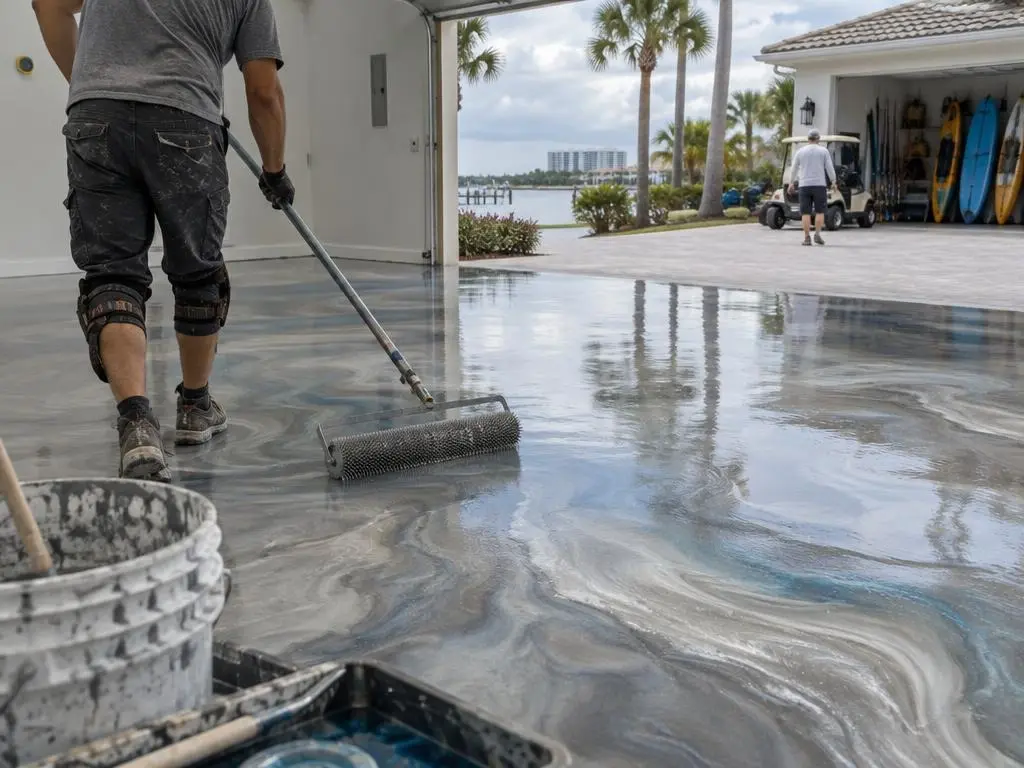
Polyaspartic sets fast. That is the benefit, and also the reason Bob Vila describes it as not a DIY product. Once mixed, it gives the installer limited time to spread it before it starts to grab. Batches stay small, the floor is divided into planned sections, and we keep a wet edge so you do not end up with lap marks or thin spots. Fast curing also means the slab prep has to be right the first time. There is no long open window to fix a missed spot. We grind, repair and vacuum the floor before any resin comes out of the can.
Weather on install day
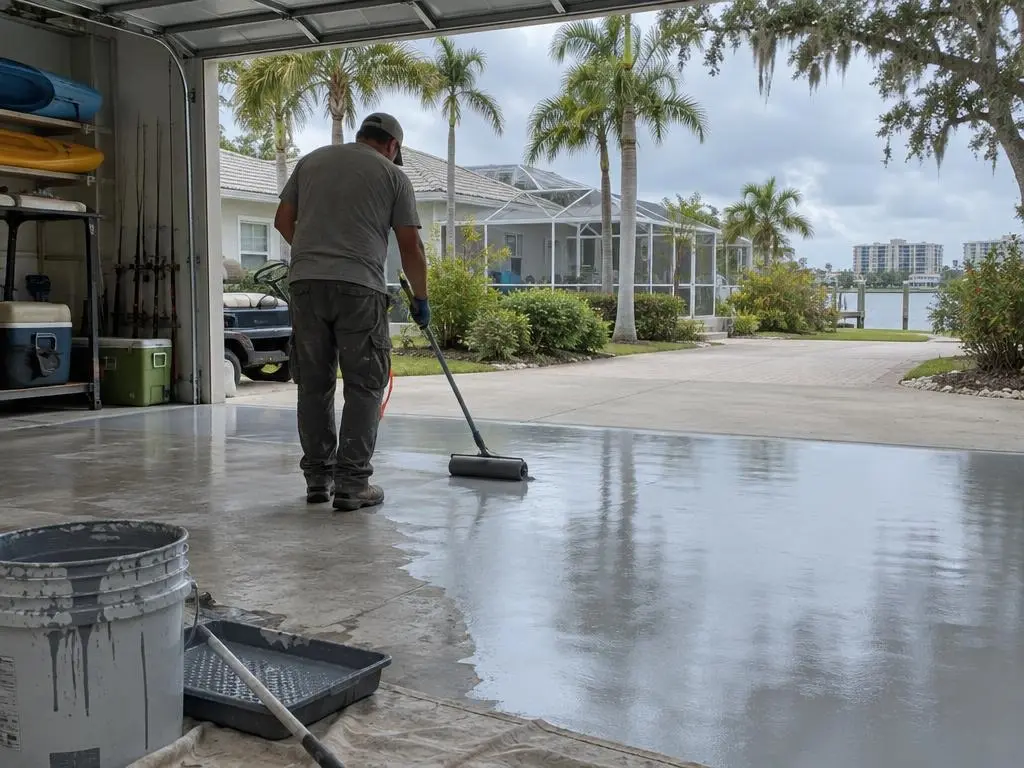
Resin floors are sensitive to the air around them. St. Petersburg collects 52.48 inches of rain in an average year, with August the soggiest month at 9.33 inches. Summer afternoons can turn from clear to pouring in an hour. We take temperature, relative humidity and dew point readings before each coat and compare the slab temperature to the dew point. When slab temperature sits near the dew point, condensation can form on the surface, clouding the finish or weakening the bond. On those days we start early, keep the door closed during coats when it is safer to, or move the coat to another day. You will not be charged for a delay we choose for the sake of the floor.
One-day and two-day installs
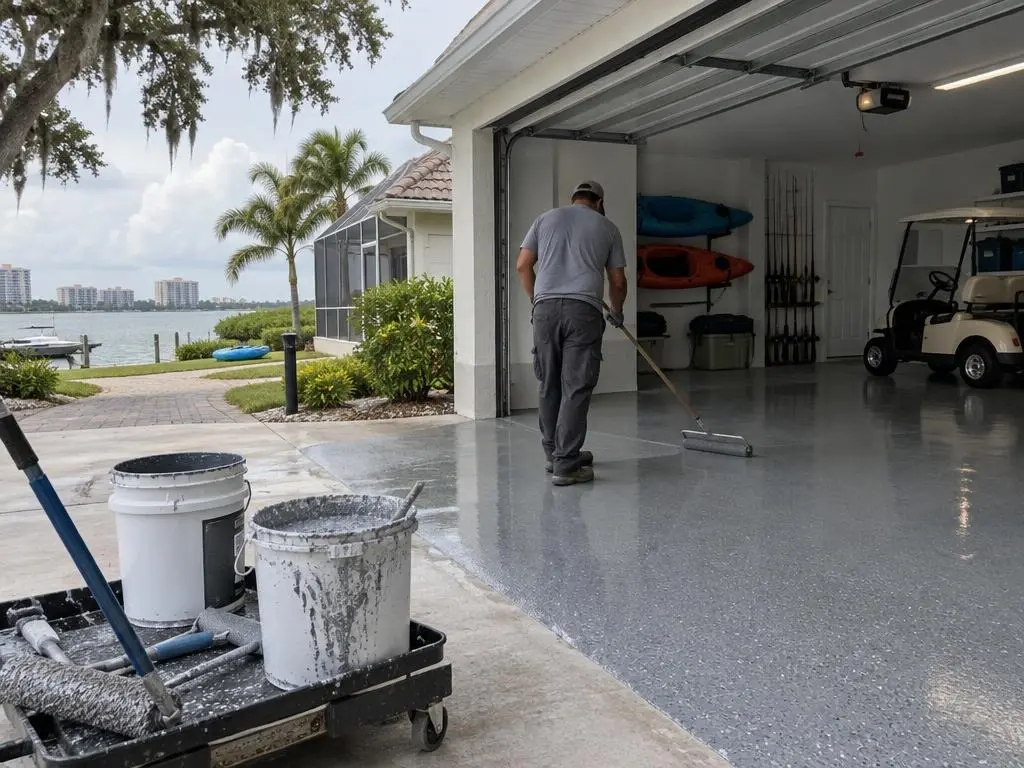
Because it cures fast, polyaspartic lets many garages go from bare concrete to finished in a single long day, or two shorter ones when the slab needs a lot of repair. That matters when the garage holds the only covered parking you have, when you are getting a house ready to sell, or when you simply do not want your car outside through a storm watch. Bob Vila points out that a business may only have to shut its doors for a day or two, and the same quick return applies at home. We will give you a realistic timeline once we see how much grinding and patching your slab needs.
Where polyaspartic earns the extra cost
By HomeGuide's numbers, polyaspartic costs $5 to $12 per square foot and epoxy $4 to $10. For a garage with the door up all day, a west-facing threshold, a carport or a lanai under a screen cage, that higher price buys color stability and a quicker return to use. In a closed, dim garage that rarely sees sun, a strong epoxy base with a polyaspartic top layer can give most of the benefit for less. Your quote will show which build we suggest and the reasoning, so you can compare.
Prep is still the deciding factor
No coating fixes poor adhesion. Point2Homes ACS figures put the median St. Petersburg home at 1969, so many slabs we see are over fifty years old, with old paint, oil and tired patches. Others flooded in 2024, when the National Hurricane Center measured a 6.31-foot storm tide on the city's gauge. We grind to open concrete, fill cracks and the worn door lip, and take moisture readings before choosing a primer. A fast-curing topcoat over a well-prepared slab is what gives you a floor that lasts.
Caring for a polyaspartic floor
Day-to-day care is simple. Sweep or dust mop sand and grit, since fine sand underfoot acts like sandpaper on any finish. A hose rinse or a mop with gentle cleaner handles the rest. Clean up battery acid, brake fluid and pool chemicals soon after a spill. Put a mat under a motorcycle kickstand or jack stand so the point load spreads out. If a heavy tool gouges the surface, the spot can be sanded and recoated. Years down the road, a worn but well-bonded polyaspartic floor can also take a fresh clear coat after scuff sanding, which brings back the gloss without starting over.
Polyaspartic Systems We Install
We match the build to how much sun the floor gets and how fast you need it back.
Full polyaspartic flake system
Polyaspartic base, full chip broadcast and polyaspartic top, often done in a day.
Epoxy base, polyaspartic top
Thick epoxy for build and bond, with a UV-stable layer over it.
Solid-color polyaspartic
Pigmented coats for a clean, uniform look that holds color in sun.
Clear recoat over sound coatings
A fresh polyaspartic top over an existing, well-bonded floor after scuff sanding.
Anti-slip additive
Fine aggregate mixed into the top layer for wet thresholds.
Carport and lanai builds
Outdoor-rated layers for covered slabs that still catch sun.
Polyaspartic Floor Coating Costs
| Job | Published range | Source |
|---|---|---|
| Polyaspartic, per square foot | $5 to $12 | HomeGuide |
| One-car garage | $1,400 to $4,700 | HomeGuide |
| Two-car garage | $2,000 to $6,900 | HomeGuide |
| Three-car garage | $2,900 to $10,400 | HomeGuide |
| Per square foot, alternate guide | $4 to $9 | Bob Vila |
| Typical project total | $1,440 to $3,240 | Bob Vila |
Published guides use national data and do not agree with each other exactly. Slab repair, the number of coats and the finish decide where a garage lands. Treat these as a yardstick; the quote we leave with you is binding.
A Typical Polyaspartic Install
1. Assess and test
We measure, take moisture readings and check how much sun the floor gets.
2. Grind and patch
Full grinding, edge work and crack repair, then a thorough vacuum.
3. Read the air
Temperature, humidity, slab temperature and dew point are checked before mixing.
4. Base and broadcast
The base goes down in sections, with flake broadcast if you chose it.
5. Top layer and return
The polyaspartic topcoat goes on, and we give you walk and parking times.
Why Choose Us for Polyaspartic Garage Coatings
Small batches, planned sections
Fast-setting resin is mixed and spread in a set order so the finish stays even.
Dew point checked every coat
We compare slab temperature to the dew point and wait when the numbers are close.
The right build, not the priciest
When a less costly hybrid build will do the job in your garage, that is what we put on the quote.
Polyaspartic Garage Coatings Questions
Should I pick polyaspartic or epoxy for my garage?
For sun and speed, polyaspartic wins. HomeGuide scores polyaspartic excellent on UV versus poor to fair for epoxy, and gives polyaspartic a 1 to 2 day cure. Epoxy builds thicker per coat, so many systems use both.
After a polyaspartic install, how many hours until the car can come back in?
HomeGuide lists heavy vehicle traffic after 24 to 48 hours and Bob Vila says about 24 hours for vehicles. On finishing day we give you a parking time for your particular floor and that day's conditions.
Can polyaspartic go down in one day?
Often, yes, on a slab that does not need major repair. Heavy grinding or crack work may push it to two days.
Does humidity affect polyaspartic?
Yes. Humid air and a slab close to the dew point can cloud the finish or weaken the bond, so we check readings before every coat and reschedule when needed.
Can I recoat my old epoxy floor with polyaspartic?
If the old coating is still well bonded, we can sand it and apply a polyaspartic top. If it is peeling, it has to come off first.
Polyaspartic Garage Coatings Service Areas
- Epoxy Flooring in St. Petersburg, FL
- Epoxy Flooring in Gulfport, FL
- Epoxy Flooring in Pinellas Park, FL
- Epoxy Flooring in Seminole, FL
- Epoxy Flooring in Largo, FL
- Epoxy Flooring in Clearwater, FL
- Epoxy Flooring in Dunedin, FL
- Epoxy Flooring in Safety Harbor, FL
- Epoxy Flooring in Oldsmar, FL
- Epoxy Flooring in Palm Harbor, FL
- Epoxy Flooring in Tarpon Springs, FL
- Epoxy Flooring in Treasure Island, FL
- Epoxy Flooring in St. Pete Beach, FL
- Epoxy Flooring in Madeira Beach, FL
- Epoxy Flooring in Indian Rocks Beach, FL
- Epoxy Flooring in Belleair, FL
- Epoxy Flooring in Kenneth City, FL
- Epoxy Flooring in South Pasadena, FL
- Epoxy Flooring in Redington Shores, FL
- Epoxy Flooring in Lealman, FL
- Epoxy Flooring in Feather Sound, FL
- Epoxy Flooring in East Lake, FL
- Epoxy Flooring in Bay Pines, FL
- Epoxy Flooring in Tierra Verde, FL
Get a Polyaspartic Garage Coatings Estimate
Free estimates for polyaspartic garage coatings anywhere in St. Petersburg and Pinellas County.